





We all know that search engines have become far more sophisticated over the past decade or so, however one principle has always remained consistent: Google, Bing and others all want to serve users the most relevant, accurate and up‑to‑date information available.
This is where the concept of content freshness comes in. While many site owners focus heavily on publishing new content, the real competitive advantage can often be in maintaining and improving what you already have.
This guide explores what content freshness actually means, how it influences SEO, and how you can build a practical, repeatable system for keeping your website content fresh.
You’ll also find a description and the background behind my latest little side project, AuditFresh, which is a free tool to help you find that stale website content you should focus your efforts on.
If you want to improve your search engine rankings, and protect your website visitors having to deal with your stale content, and build a sustainable content strategy, this is the place to start.
What is content freshness?
Before we get stuck into it, let’s go through exactly what it is. Content freshness refers to how up‑to‑date, relevant and accurate a piece of content is in relation to the search query it aims to satisfy.
It’s not simply about the date something was published or updated. Instead, it’s actually about whether the content reflects the latest information, trends, data, user expectations and search intent.
Many people confuse freshness with recency. Recency is about time. Freshness is about relevance.
As an example, a five‑year‑old article on the history of the Roman Empire can still be perfectly fresh if the information hasn’t changed. I mean, we dont know any more about Octavian and Romulus Augustulus now than we did five years ago.
Yet, on the other hand, a two‑month‑old article about social media marketing trends may already be stale if it doesn’t reflect new platform features or algorithm changes. Look how often Instagram has been changing image sizes and their ranking criteria in the last three months.
Google’s approach to freshness is nuanced. It applies stronger freshness signals to queries where new information is genuinely valuable. This is known as QDF (Query Deserves Freshness).
Topics such as breaking news, product updates, emerging technologies and price comparisons often fall into this category. Evergreen topics such as our roman empire example, however, rely more on depth, accuracy and authority than constant updates.
Understanding this distinction helps you avoid wasting time updating content that doesn’t need it, while focusing your energy and precious time where it will have the greatest impact.
How content freshness impacts SEO performance
So, content freshness affects SEO in several ways, some that are quite direct and others that are more subtle. Let’s dig down into some of these.
Improved relevance signals
Search engines want to deliver the most useful answer. When your content reflects current information, it’s more likely to satisfy user intent, which in turn improves engagement metrics such as dwell time and click‑through rate.
Better alignment with search intent
Search intent evolves. A guide written in 2020 about free blogging tools will not match the expectations of a 2026 reader unless it reflects the current landscape of tools that are out there. Updating your content regularly ensures that it will continue to align with what users are actually searching for.
Enhanced E‑E‑A‑T
Fresh content supports Experience, Expertise, Authoritativeness and Trustworthiness. Outdated information undermines trust, especially in industries like finance, health, technology and law. Have you ever started reading an article, and then end up dismissing it because it says ‘Published 17 April 2008’? We have all been there!
Protection against content decay
Content decay is the gradual decline in website traffic and rankings over time. This often happens because competitors publish fresher, more comprehensive content. Regular updates help you optimise your blog posts, maintain your SERP position and prevent slow erosion of visibility.
Increased internal linking opportunities
Refreshing content allows you to add new internal links, which strengthens your site architecture and helps search engines understand topical relationships.
As an example, say you have 50 blog posts. There’s a very good chance that the latest 5 posts don’t have any internal links to them, because the other 45 blog posts were written before they existed. Makes sense right? Well, go back and add links to your newer posts into your older posts, to share the internal link love.
Freshness isn’t a magic bullet, but it is a powerful lever when it is used strategically.

How to measure content freshness
Most websites don’t really have a clear way to evaluate freshness, which leads to guesswork and inconsistent updates.
Creating a simple scoring model such as my example below can help you prioritise what to refresh and when.
The Content Freshness Score (0–100)
You can score each piece of content using the following factors:
- Last update date
More recent updates score higher, but only if they were meaningful. - SERP volatility
If rankings for your target keyword fluctuate frequently, freshness matters more. - Competitor update frequency
If competitors update their content every few months, you’ll need to match or exceed that. - Content depth and completeness
Does your content reflect current standards for comprehensiveness? - Link freshness
New backlinks and updated internal links contribute to perceived freshness. - Accuracy of data and examples
Outdated statistics or screenshots lower the score.
A score below 60 usually indicates that content needs attention. Anything below 40 is likely costing you traffic and needs updating quickly.
How often should you update content?
Sorry, there’s no single rule that applies to every website. However, understanding how freshness interacts with different content types can help you build a realistic and effective update schedule.
The goal isn’t to update everything constantly. It’s to update the right things at the right time, based on how users search and how quickly information changes.
Think of content freshness as a maintenance cycle rather than a one‑off task. Just as you wouldn’t service every vehicle in a fleet on the same day, you shouldn’t treat all content equally.
Some pages need frequent attention, while others can theoretically remain untouched for years without losing any relevance.
Below is a more detailed breakdown of update frequency by content type, along with the reasoning behind each recommendation.
Blog posts
Most general blog posts benefit from a review every 6–12 months. This timeframe works because blog content often includes:
- statistics that age quickly
- examples tied to trends
- references to tools or platforms that evolve
- insights that may shift as industries change
A review doesn’t always mean a full rewrite.
Sometimes a few updated stats, a new paragraph, or a clearer structure is enough to maintain freshness. The key is to ensure the post still aligns with current search intent and user expectations.
Evergreen guides
Evergreen content is designed to stay relevant for long periods, but that doesn’t mean it should be ignored. Reviewing these guides annually helps you:
- update outdated examples
- add new insights or research
- expand sections that competitors have improved
- refine structure to match modern content standards
Evergreen content often drives consistent traffic, so even small improvements can deliver strong returns.
Product pages
Product pages should be updated whenever something changes. This includes:
- pricing
- features
- availability
- specifications
- shipping details
- compatibility information
Users expect accuracy on product pages, and search engines penalise outdated or misleading information.
If your product catalogue is large, consider implementing a quarterly review cycle to catch anything that may have slipped through.
Local pages
Local SEO relies heavily on accuracy. Update local pages whenever:
- opening hours change
- service areas expand or contract
- contact details are updated
- new reviews or testimonials are added
- local regulations shift
Even if nothing changes, an annual review ensures your local pages remain competitive and aligned with current search behaviour.
News content
News content has the shortest freshness window.
Search engines prioritise recency for news‑driven queries, especially in the first 24–48 hours. After that, updates are only necessary if:
- new facts emerge
- corrections are required
- additional context becomes available
News content rarely benefits from long‑term updates unless it transitions into an evergreen explainer.
Technical documentation
Technical documentation should always be updated as soon as the underlying technology changes. This includes:
- software updates
- API changes
- new features
- deprecated functionality
- security updates
Users rely on documentation for accuracy, and outdated information can cause frustration or errors.
A quarterly review cycle is a good baseline, but major updates should trigger immediate revisions. Make sure to update all your screen captures too – there’s nothing worse than displaying a previous version of your product when explaining how it works.
Comparison articles
Comparison content is highly sensitive to freshness because it often includes:
- pricing
- feature lists
- pros and cons
- product availability
- new model releases
You should review these articles at least every 3–6 months, or sooner if you operate in a fast‑moving industry like technology, finance or software.
How to determine your ideal update frequency
While the guidelines above provide a starting point, your ideal update schedule depends on:
- how competitive your niche is
- how quickly information changes
- how often competitors update their content
- how important the page is to your traffic or revenue
- how volatile the SERP is for your target keyword
A practical approach is to categorise your content into three buckets:
High‑volatility content
Topics that change frequently or attract heavy competition. Review every 3–6 months.
Medium‑volatility content
Topics that evolve slowly but still require periodic updates. Review every 6–12 months.
Low‑volatility content
Evergreen topics with stable search intent. Review annually.
This practical yet simple system then helps you allocate your time and efforts where they matter most.
Signs your content needs updating sooner
Regardless of your schedule, there are certain signals that can indicate that one of your pages needs attention:
- Rankings have dropped by more than a few positions
- Traffic has declined steadily over several months
- Competitors have updated their content
- SERP features have changed (e.g., new featured snippets)
- Your content no longer matches search intent
- You’ve received user feedback pointing out outdated information
When you see these signs, it’s worth reviewing the page even if it’s ahead of its scheduled update.
Why update frequency matters
Updating content isn’t just about staying accurate. It also helps you:
- maintain topical authority
- strengthen internal linking
- improve user satisfaction
- protect your rankings from competitors
- reduce the risk of content decay
- keep your site aligned with modern SEO standards
A thoughtful update schedule ensures your content library remains a living asset rather than a static archive.
Introducing my free content freshness tool
Over the past few years, I’ve often thought about how to make content freshness easier, faster and more practical for me to manage. Especially when I had 3-5 blogs with literally hundreds of pages to manage.
Most tools that I could use in this space are either too complex or too expensive. So recently, I decided to build something simple, useful and completely free.
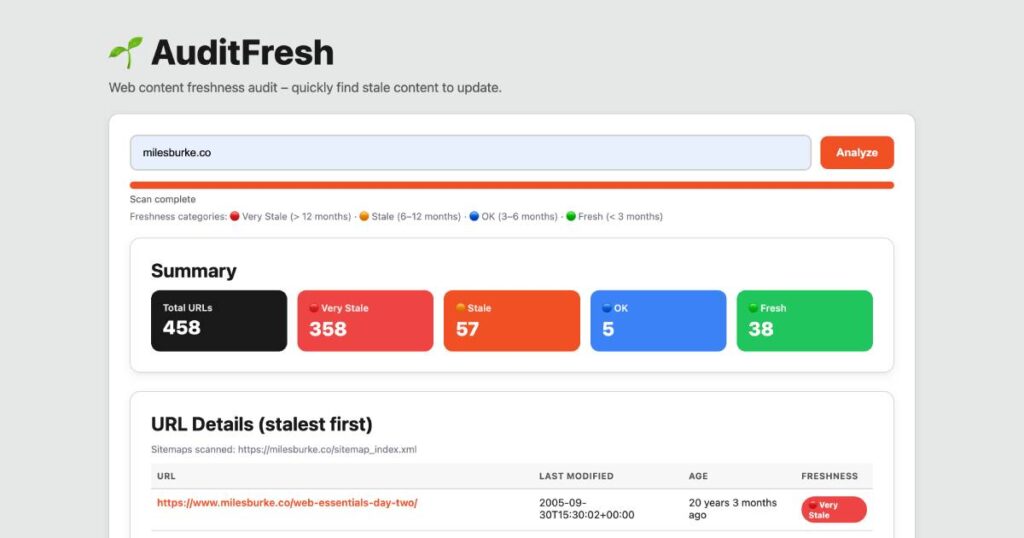
That’s how my content freshness tool, AuditFresh, came to life. I created it as a little side project, because I wanted a fast and simple way to check how fresh or stale some pages are within a website, without having to dig through spreadsheets or running complicated audits.
This one page tool analyses any URL and gives you a quick, clear snapshot of its freshness signals, including last updated date and age. It then ranks the order of importance, so you have a good checklist of pages to update first.
My goal was to make something that anyone could use—bloggers, marketers, small business owners, or anyone who wants to keep their content performing well without spending hours on manual checks. There’s no login, no subscription and no upsell. You simply type in your domain name, and the tool will do the rest.
AuditFresh is designed to help you spot issues quickly so you can focus on meaningful improvements rather than guesswork.
I built it because I needed it myself, and I’m making it available for free because I know how valuable a simple, reliable content freshness check can be.
If you’re serious about keeping your content competitive, it’s a handy tool to keep bookmarked. If you have any feedback about it, I’d love to hear that too!
A step‑by‑step content freshness audit
A content freshness audit helps you identify which pages need attention and in what order.
Step 1: Crawl your site
Use a tool such as AuditFresh to extract URLs, metadata, publish dates and update dates.
Step 2: Identify stale content
Using Analytics or SEO tools, look for pages with declining traffic, outdated information or old screenshots.
Step 3: Prioritise by impact
Focus your time and efforts on:
- High‑traffic pages
- Pages ranking between positions 5–20
- Pages with strong conversion potential
- Pages targeting freshness‑sensitive queries
Step 4: Assign a freshness score
Use the scoring model I mentioned above to quantify the level of staleness.
Step 5: Build a refresh calendar
Schedule updates based on priority and resource availability.
This way, a structured audit will ensure that you’re not simply updating content at random and wasting all of your efforts on the wrong areas.
Quick updates for content freshness wins
Before you start hyperventilating, not every content update needs to be a major overhaul. Phew!
In fact, some of the most effective freshness improvements come from small, targeted changes that take only a few minutes but signal to search engines that your page is being actively maintained.
These quick wins help you stay competitive, improve user experience and protect your rankings without requiring a full rewrite.
Below are simple, high‑impact updates you can apply during any content review.
Update titles and subheadings with the current year
Adding the current year to your title or key headings can improve click‑through rates and signal recency. This works particularly well for guides, comparisons, trend pieces and how‑to content.
For example:
- “Best Productivity Tools” becomes “Best Productivity Tools for 2026”
- “How to Start a Blog” becomes “How to Start a Blog in 2026”
Just make sure the content actually reflects the updated year. A date‑stamped title without meaningful updates can harm trust.
Update research links to newer studies
If your content references statistics, surveys or industry reports, check whether newer research is available. Replacing outdated sources with current data strengthens your authority and ensures accuracy.
This is especially important in fast‑moving fields such as:
- digital marketing
- technology
- finance
- health
- consumer behaviour
Even a single updated statistic can make a page feel significantly fresher.
Add more internal links, especially to newer content
Internal linking is one of the easiest and most overlooked freshness signals. Adding links to newer blog posts, updated guides or relevant product pages helps search engines understand topical relationships and encourages deeper user engagement.
You should look for opportunities to:
- link older content to newer articles
- add links to cornerstone pages
- connect related topics that weren’t previously published
This also helps distribute authority across your site more effectively.
Create new visuals such as checklists or updated screenshots
Visuals age quickly. Screenshots become outdated as interfaces change, and diagrams or charts can look stale after a few years.
Refreshing visuals can include:
- updated screenshots of tools or dashboards
- new diagrams or flowcharts
- simple checklist graphics
- comparison tables with current information
These updates improve clarity and user experience while signalling that the content has been actively maintained.
Create supporting resources such as downloadable PDFs
Offering a downloadable resource adds value and gives users a reason to stay longer on the page. It also positions your content as more comprehensive than competitors’.
Useful downloadable assets include:
- checklists
- templates
- worksheets
- summary guides
- audit frameworks
These resources can be created once and reused across multiple pieces of content.
Add phrases the page is now ranking for
Over time, your page may begin ranking for new keywords you didn’t originally target. Incorporating these phrases naturally into your content helps reinforce relevance and improve rankings.
You can weave these terms into:
- subheadings
- FAQs
- short paragraphs
- examples
- definitions
This ensures your content aligns with real search behaviour and captures additional traffic without creating new pages.
The content refresh workflow
A consistent workflow helps you update content efficiently and effectively. As I have covered above, you should focus on steps such as below.
Step 1: Revalidate search intent
Search the target keyword and analyse the top results. Has the intent shifted? Are new subtopics appearing?
Step 2: Update data, examples and screenshots
Replace outdated statistics, broken links and old visuals.
Step 3: Improve structure and readability
Modern content tends to be more scannable, with clearer headings and shorter paragraphs.
Step 4: Add missing subtopics
If competitors cover areas you don’t, fill those gaps.
Step 5: Strengthen internal linking
Add links to newer content and ensure older pages link back to the refreshed piece.
Step 6: Reindex and monitor
Request indexing in Google Search Console and track performance over the next few weeks.
This workflow ensures each update is meaningful rather than superficial.
Content freshness myths
Content freshness is often talked about but rarely understood in a practical way. Misconceptions can lead to wasted effort, unnecessary rewrites or strategies that don’t actually improve performance.
Clearing up these myths helps you focus on updates that genuinely strengthen your content and support long‑term SEO results.
One common misunderstanding is the idea that every page needs constant updating. In reality, some topics barely change from year to year, and refreshing them too often can introduce errors or dilute their clarity.
Evergreen content remains valuable precisely because it doesn’t require frequent revision. The real question is whether anything has changed that affects the accuracy or usefulness of the page, not whether the calendar has ticked over.
Another misconception is that freshness only matters for news. While breaking stories and time‑sensitive topics obviously rely on recency, many other categories benefit from updated information.
Product comparisons, pricing guides, software tutorials, regulatory content and trend‑based articles all evolve quickly. Users expect these pages to reflect the current landscape, and search engines reward content that keeps pace.
Some people believe that simply changing the publish date or adding “Updated for 2026” is enough to boost rankings. Search engines are far more sophisticated than most people think. They can detect whether meaningful changes have been made.
Cosmetic updates without substance won’t improve performance and may even undermine trust with readers who expect genuine improvements.
There’s also a tendency to assume that publishing new content is always better than updating old content. In practice, older pages often carry more authority, backlinks and historical engagement.
Enhancing an existing high‑value page can deliver faster gains than starting from scratch. A balanced strategy involves both creating new material and maintaining what already works.
Another myth is that freshness is a ranking factor for every query. Some topics simply don’t change, and search engines know this. A tutorial on tying a tie or a post on how to make debtors pay probably doesn’t need constant revision.
Freshness matters most when user expectations or the underlying information shift. Understanding which queries deserve freshness helps you allocate your time wisely.
Many teams assume that updating content means rewriting it entirely. In most cases, small but meaningful improvements; updated statistics, clearer structure, new internal links or refreshed visuals; are more than enough.
Full rewrites are only necessary when the original content no longer aligns with search intent or industry standards.
It’s also easy to overlook the fact that freshness extends beyond the words on the page. New backlinks, updated metadata, improved internal linking and increased user engagement all contribute to perceived freshness. Search engines look at the overall activity surrounding a page, not just the text itself.
Finally, some believe that frequent updates automatically lead to better rankings. Over‑updating can actually cause instability, confuse search engines or disrupt keyword alignment. Freshness should be applied with intention, not as a constant churn of edits.
Understanding these myths helps you approach content freshness with clarity and purpose. When you focus on meaningful updates rather than superficial changes, you build a content library that remains accurate, competitive and genuinely useful over time.
Simple checklist to keep your content fresh (add to your calendar!)
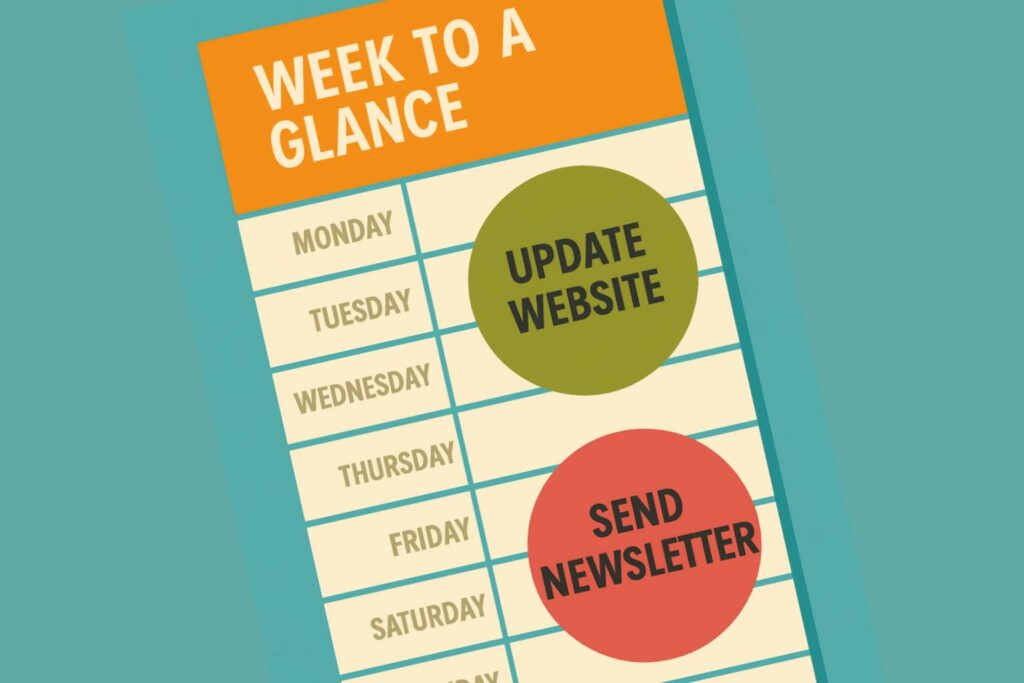
Below I have written a simple checklist to help you stay on track with updating your website content without overwhelming you entirely.
Weekly
- Monitor traffic and rankings for signs of decay.
- Review SERP changes for your top keywords.
Monthly
- Refresh at least one high‑value page.
- Add internal links to new content.
Quarterly
- Conduct a mini‑audit of your top 50 pages.
- Update statistics, screenshots and examples.
Annually
- Perform a full content audit.
- Reassess your content strategy based on performance.
By following this checklist, you’ll maintain a strong, competitive content library that continues to perform year after year.
Conclusion
Content freshness isn’t about chasing trends or constantly rewriting your entire website. It’s about maintaining a living, evolving library of information that continues to serve your audience well over time.
When you approach freshness strategically; by understanding which pages deserve updates, how often they need attention and what kinds of improvements actually matter; you build a content ecosystem that stays competitive long after the initial publish date.
The most successful websites treat content as an asset that requires ongoing care. They monitor performance, respond to shifts in search intent, update data, refine structure and strengthen internal links.
They also recognise that small, thoughtful updates can be just as powerful as major rewrites.
Whether you’re refreshing a high‑performing guide, updating a comparison article or simply adding new internal links, each improvement contributes to a stronger, more resilient content strategy.
As search engines continue to prioritise relevance, accuracy and user satisfaction, content freshness will remain a critical part of long‑term SEO success.
By applying the concepts, workflows and quick wins outlined in the above guide, I believe you’ll be well‑positioned to maintain visibility, protect your rankings and deliver genuinely valuable content that stands the test of time.